
Understanding Oregon’s King Tides
Updated: Apr 7
Discover what causes Oregon’s dramatic winter King Tides, how they shape our coastline, and how to view them safely.

By Rhiannon Bezore, Coastal Shores Specialist, Oregon Department of Land Conservation and Development
Published: December 2025
What Are King Tides?
Each winter, the moon, sun, and earth are in alignment, the earth’s orbit is closest to the sun, and the moon is closest to the earth, creating an extra strong gravitational pull on our oceans, making the highest and lowest tides of the year. These extreme tides are known scientifically as Perigean Spring Tides, but they are more commonly referred to as King Tides.
This season (2025 to 2026), we have three King Tide events. The first took place November 5 to 7, the second December 4 to 6, and the final event will occur January 1 to 4.
Where the Term “King Tides”Comes From
The term “King Tides” was coined in Australia nearly 20 years ago to describe the highest tides they observed each year, and the King Tides Project began to document how the tides were impacting coastal communities. From there, the project spread across the world.
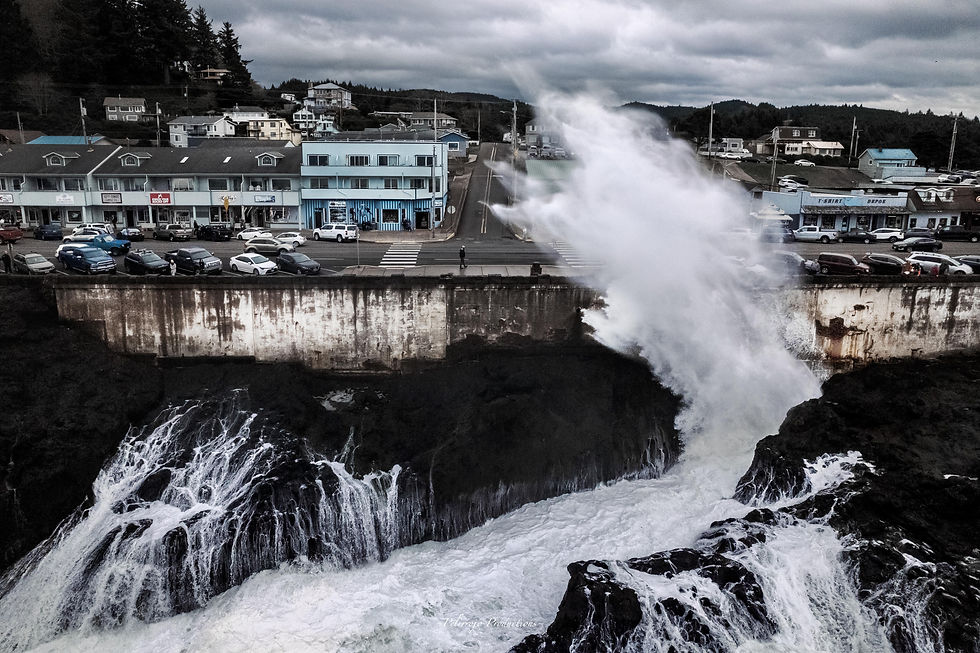
The Oregon King Tides Project
The Oregon King Tides Project began 15 years ago as a partnership between the Oregon Coastal Management Program (housed within the Oregon Department of Land Conservation and Development) and Oregon Shores Conservation Coalition, along with partners from Oregon Coastal Visitors Association, Oregon Sea Grant, and Oregon Surfrider. The Oregon King Tides Project is a community science initiative that asks the public to submit their photos of the King Tides online to www.oregonkingtides.net.
The project hosts a photo contest each year and shares all photos submitted to a public Flickr account (Oregon King Tides’s albums | Flickr) as well as with coastal planning departments, federal and state agencies, and researchers. The project is focused on documenting howKing Tides impact our coastal communities, be it flooding, erosion, or other compounding impacts from storms that add to the effects of the high tides. Seeing areas that are already being impacted by these high tide events gives us a glimpse into what future sea level rise may look like in our communities.
What King Tides Tell Us About the Future
Essentially, the water levels that we see during king tides now may be the normal high tide line in the future with sea level rise, with King Tides then raising water levels that much more each winter. Since King Tides occur during winter months, they often coincide with storm events too. This can lead to large waves and stormy conditions during peak high tide hours, increasing hazards like flooding, erosion, and sneaker waves along the coast.
Staying Safe While Viewing King Tides
It is very important that anyone visiting the coast be very careful when viewing King Tides. The ocean is incredibly powerful, sneaker waves can happen at any time, and King Tides often coincide with storms, producing large waves during already high water levels.
People taking photos and videos should be a safe distance from the water and never turn their back on the water. Remember to stay off of logs and rocks, away from cliff edges, and on dry sand. There are plenty of safe places to view the King Tides without putting yourself in harm’s way.
Contact Information
For more information about the project, please contact:
Rhiannon Bezore, Coastal Shores Specialist with the Oregon Department of Land Conservation and Development, (971) 375-7336, rhiannon.bezore@dlcd.oregon.gov
Sam Derrenbacher, Community Science & Engagement Manager with Oregon Shores, (603) 340-4648, sam@oregonshores.org


